Networks
In PiNN, a “network” is a function with learnable parameters, which
yields atomic predictions from a structure, e.g. the coord and
elems.
Structures of ANN
Note
The current section explains how PiNN represents atomic neural networks in TensorFlow. This should be helpful if you are trying to modify or create a neural network. But you might not need to read this if you just want to use one of our implemented networks. In that case, you could jump to Implemented networks.
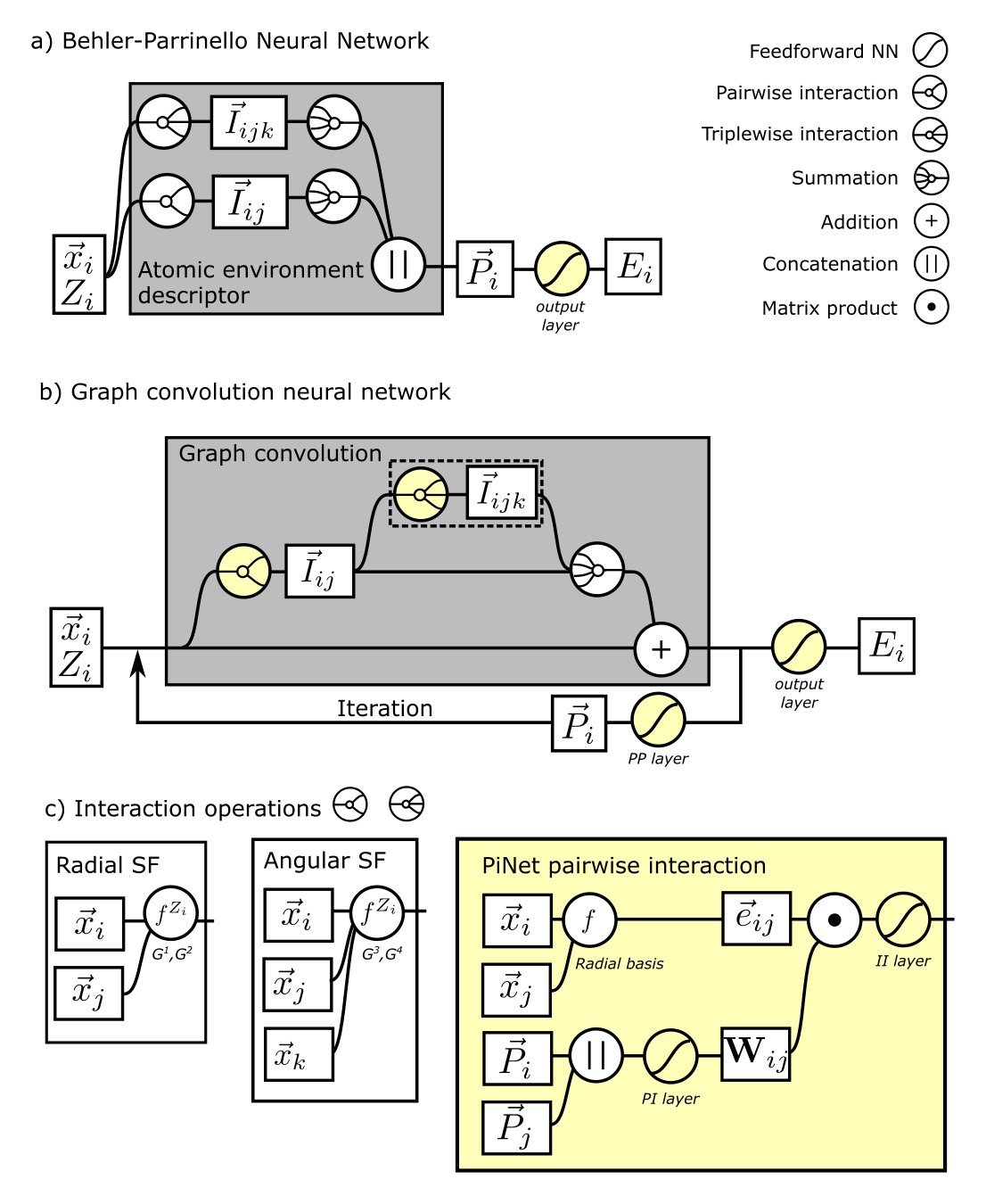
Fig. Schematic illustration of different ANN structures
As shown in the illustration, most operations of the atomic neural networks are arithmetic operations or feed-forward neural networks for atomic properties or interactions. Those operations can be easily represented using TensorFlow operations. However, the pairwise(or triple-wise) interactions and the interaction pooling operations involve the communication between atoms and their neighbors, which required special treatments.
PiNN’s representation of ANNs
In PiNN, the interactions are represented as sparse slices of the
non-zero values in the \(\vec{I_{ij}}\) tensor (a n_nodes vector
for each pair of atoms). A (n_pairs, 2) tensor named as ind_2
is used to index the pair. The pairwise interaction and interaction
pooling are then done with TensorFlow’s gather_nd and
unsorted_segment_sum operations. Notably, PiNN provides a neighbor
list layer to get ind_2, the pinn.layers.cell_list_nl layer
implements a cell lists algorithm which produces the ind_2 tensor
as well as the pairwise distances and displacements tensors.
Similarly, a (n_atoms, 1) tensor named as ind_1 is used to
index each atom’s position in a batch. And as is done in BPNN, a
(n_triplet, 2) tensor named as ind_3 is used to index each
triplet with two pairs sharing the same central atom.
You can find a demonstration about building an atomic neural network with PiNN in this notebook.